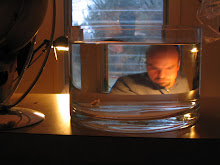
One of the more modest highlights of last summer involved a late afternoon - lambent, the poets would call it - at Patterson Park, where we fulfilled a Baltimore goal of mine by seeing the locally famous All Mighty Senators live, on the slope. And, months later, what still sticks with me from that show is the tight, focused energy and controlled humor of one song, whose joyful refrain ran: "Everybody knows I've got no clothes on / Underneath my clothes."
Roughly nine months later, one of Cleo's favorite words is nuku, which implies nakedness, is usually pronounced with a cavalier delight, and which may derive (say the local etymologists) from 'no clothes.' Did the roots of Cleo's neologism first take shape, before she could talk, while she watched the All Mighty Senators?
I can't answer that. But, for the moment, I can assure you that there's rarely any ambiguity about what Cleo's wearing, underneath her clothes. Delighted that she can put on her own pants, but still unable to pull them up all the way, she proudly shows the world that she's sporting a onesie, underneath those clothes.
Tuesday, March 22, 2011
Underneath her clothes

Friday, March 18, 2011
Ritual
 At some point in the late summer of 2009 (we think, straining our viscous memories), Lisa put the above disc into a C.D. player in Cleo's bedroom, while nursing, and slowly rocked our daughter back to sleep, to a gentle, eclectic soundtrack.
Since then, Cleo's gone to sleep with these sounds in the background at least 500 times. She's heard it in Santa Monica; she's heard it in Chapel Hill. It's played in dark rooms, curtains drawn, in both Virginia and West Virginia. And, this summer, it'll likely make the trip to South Africa.
There's nothing necessarily exceptional about the songs; the artists aren't particularly well known (although Carlos Santana does make an appropriately restrained appearance), and the songs are largely in languages other than European tongues, rendering the lyrics meaningless to us and to Cleo. But mommy (and the designers behind the disc) chose well: throughout, there's a restfulness, a fullness, and a soft presence that are perfect for bedtime. And so, over time, Cleo's not the only one who's come to associate the songs with an easy slope into sleep. When I happen to be putting her to bed, and I hear the sounds lilting in the background, my eyes grow heavy, as well.
If the disc has real soporific powers, though, it's also done neat work as a ground, against which Cleo can grow. A year and a half ago, she was a little bean that we planted in the field of her crib. Now, she sometimes wakes up, stands in her crib, leans over the rail, opens the C.D. player, grabs the disc, puts it in, lowers the cover, and presses play. The first time this happened, it caught me by surprise: I entered the room at the end of a nap, and found Cleo listening to a very, very familiar soundtrack. Who'd been, I wondered, in the room? And what intruder knew about our C.D., or would care enough to play it?
But miracles, repeated often enough, become merely unusual, and then become rote. The very fact that we can press a button and hear Carlos Santana bending notes is, in a way, miraculous. So, too, is Cleo's ability to summon him. As time has passed, though, both have become merely pleasant aspects associated with a disc that forms the center of one of our oldest family rituals.
Saturday, March 12, 2011
In praise of bells
 Bells, I'm coming to think, deserve a slightly more vaunted place in the jumbled pantheon of musical instruments.
They seem to be assigned to, tacitly, or quietly, or thoughtlessly, a second tier: they occupy, I'd argue, a place on the same mental shelf as the mandolin, or the harmonica, or the sitar. Yes, we know they have their place, and their moments - but, really, bells? How many glockenspielers can you name?
But they deserve better, as a certain toddler is teaching me. Since we spent, a couple of weeks ago, a full half hour in a tiny, toddler-scaled wooden locomotive, ringing the stout brass bell at least 50 times, I've noticed that bells are much more common, in the fabric of our lives, than I'd imagined. And not only are are they consistently present: they almost always acquit themselves in style. The clock on the spire of Corpus Christi, across from my office at MICA? Its daily chime at 12:10 is a timeless reminder of larger concerns. Two small bells, brought back from Japan by thoughtful grandparents, sit on a counter in our West Virginia barn, awaiting the arrival of Cleo's small hands, in whose grasp they tinkle gracefully. A cow, in one of Cleo's board books, wears a bell, and the thought of its sound in the colorful meadow beyond brings no small pleasure. And then there's the light rail train, with its satisfying bell delicately heralding its bulking presence, as we take a sharp turn.
Violins, pianos, and saxophones all have their partisans, their odes. Toddlers, not yet drenched in the canon, openly admit the fascination of other sounds, as well.
Sunday, March 6, 2011
Through the generations
 A few months ago The Times ran a rather simple, but surprisingly touching, feature about a man named Dave Levitt - a 40-year-old music specialist who now works at a largely Jewish daytime care program for retirees, but whose experience as a klezmer player is rooted in generations of familial experience. His great-grandfather, Max Levinsky, was a shtetl violinist who emigrated from Ukraine in the 1880s; his grandfather played the trombone with a group known as the Boibriker Kapelle, and his father headed the Marty Levitt Orchestra. As a result, when Levitt plays his klezmer before a few dozen aged men and women - some Jewish, and some not - he can draw on decades of accured familial experience. Or, to put it in rather sappier terms, his playing is both informed by, and gives voice to, his ancestors.
Over the past nine eight days, we've been lucky enough to enjoy weekend visits by all four of Cleo's grandparents. And while Cleo can't claim, like Levitt, a premature talent on an instrument - today she struggled with a whistle, emitting nothing more than a tiny whisper, before giving up - it's certainly clear that she's inherited an array of other sorts of gifts from them. Some are only nascent; some have not yet manifested themselves. But in years to come, she'll be, I don't doubt, her grandparents' child, in many ways.
Of course, in at least one sense, she already is. “I was brought up," Levitt told The Times, "with an elderly audience." And that's more or less what Cleo enjoyed, as well, these past Saturdays and Sundays. Whether she was riding the light rail, or taking a bath, or merely eating her yogurt, she had a warm and appreciative audience. But don't be too cocky, Cleo. Although they love to watch you, you need to remember that you are what you are because of, and only because of, all four of them. They're not merely audience, in other words; they're your past, and in many ways, your future. You'll get better, I'm sure, at blowing that whistle. But you'll never be the first, I can tell you now, to do it well.
Monday, February 21, 2011
The beauty of the detail
 Several weeks ago I led my historiography class in a discussion of the work of Giovanni Morelli, a 19th-century connoisseur of Renaissance paintings who is still reasonably well known for his idea that an artist will reveal his individual style most obviously in minor details (earlobes, say, or thumbnails) that are unlikely to be studied closely by most viewers and that have not inspired common formulas. It's a neat thought, and one that still colors some work being done today, but in reading Morelli this time around I was also struck by the value of his simple willingness to look long, and closely, at paintings. Too often, we miss the detail in the corner of the painting in our hurry to get a sense of the museum wing as a whole; we scan, instead of devoting ourselves; we save time, instead of taking time.
I don't mean to imply, though, that I'm somehow above such habits. If anything, I'm more guilty than most; en route to a story time, or pushing to grade papers during Cleo's nap, I've hardly had the time, of late, to study much of anything closely. But for that very reason, two recent experiences have stood out to me - experiences that underline the beauty of the incidental, or the value of the transient.
More matter, my readers say, with less art. Okay. Since New Year's, I've been a gym rat in the way that 40-year-old dads are gym rats: abbreviated workouts, at random times of day, in gym clothes that date from the late Nineties. But I've enjoyed it, and I've even come to enjoy the fact that the weight room's sound system is permanently tuned to a satellite radio station that only plays the Top 20, in an infinite loop that varies only slightly from week to week. As a result, I've become deeply familiar, for the first time since about 1985, with mainstream, top-of-the-charts pop. Kesha's "We Are Who We Are"? I've heard it at least a dozen times. Enrique Iglesias? You bet. The Script, Bruno Mars: they're like a Greek chorus, commenting as I struggle with the bar on the decline bench. But while some of the songs grate, and others simply fade from memory, I've been struck by the impact of a few small details. Take, for instance, Katy Perry's popular "Firework": after about 45 seconds of utterly conventional, intoned five- and six-syllable lines that bounce between two or three notes, she creates a potent briedge by singing "ignite/the light" in a rising cascade (A-flat; B-flat; C; B-flat; D-flat) that surprises in its richness, suddenly justifying the plodding opening through an uplifting contrast that's the very point, I think, of the song.
Or this. Part of Cleo's bedtime ritual, like many kids', involves sitting down with a book or two, for a goodnight read. We usually let her choose the titles, from a small pile of bedside books; for s a time, her favorite was Goodnight Moon, and lately it's been the lovely Good Night, Gorilla. No surprises here, as both are old favorites - and I don't think any parents reading this would be surprised, either, to hear me observe that it can take a little creativity to avoid getting a little tired of the same read, night after night. But that's exactly where the small details matter. Sure, I've read Goodnight Moon with Cleo many, many times. But it took me, in fact, quite a few of those reads before I noticed that the moon rises, subtly, in the sky outside the window, and that the tiny mouse scampers from place to place, as we bid goodnight to the brush, the mush, the cows and the bears. Similarly, Good Night Gorilla offers a gentle, engrossing central narrative - but it also rewards the attentive reader in its treatment of a rising balloon, in the representation of photos on a shadowed wall, and in the place of a flashlight. Even the number of neighbors in a tiny, lit window in the distance changes over the course of a story: are they watching what we're seeing, as well?
I don't know. And I don't know if such details reveal, as Morelli might suggest, the idiosyncratic habits of Clement Hurd or Peggy Rathman. Nonetheless, they serve their small purpose - to give back to those who give time - beautifully.
Sunday, February 20, 2011
The choices we make
 Driving on a back road in West Virginia this morning, with an oldies station on the radio, and suddenly Canned Heat's "On the Road Again" was playing on the speakers. It's not a song I know well, but the reason I do know it is meaningful, at least to me: it was one of the very few rock songs that my dad owned, when I was a kid. On the shelf under his record player, to the side of the large albums of concerti, symphonies, and airs, stood a few 45s. And one of those was Canned Heat.
But why, I wondered as I drove and listened, had he chosen that song in particular? Assuming that he had in fact bought the record, I tried to come up with possible explanations. Had the song somehow appealed to a momentarily latent Wanderlust? Did the evocation of a sitar remind him of his travels in south Asia? Did the melody just, well, you know?
Such questions, ultimately, can't ever be finally answered, without asking the subject. But, in a sense, they also answer themselves: who knows, ultimately, why we favor one song over another? Sure, the psychoanalysts will offer one reason, and the evolutionary psychologists another. To you, it might have been a matter of taste; to another, perhaps it was chance, or the result of a subtle advertising cue. But as each of us makes our case for a particular explanation, look at what we're really doing: we're only repeating, in a way, the same sort of unglossable choice that my dad once made. You choose a Jungian approach. He chose Canned Heat.
And Cleo? Yesterday afternoon, Cleo and I spent about 20 minutes just sitting, alone, in the car, having what might almost be called a conversation. The highlights were several, and simple. She can now reach, on her own, the overhead light. She can also turn the car on, due to the Toyota's large button-fired ignition. She's also on the verge of counting: at one point, she pointed to our car, said car, pointed to a second, nearby vehicle, said car again - and then pointed quickly to both, and said two. But my favorite moment was when I explained to her that the next morning we'd be going to a restaurant for breakfast. I told her who would be there, and what sort of a place it would be. And then I asked her what she might order. Her answer? Butter.
The choices we make define us, in part. But so, too, do the various ways in which we interpret those choices. Canned Heat, butter; an acceptance of eccentricity, elaborate theories. And there the record stood, to the side of the symphonies, the concerti, the airs.
Tuesday, February 15, 2011
Steam
 So: once, in 1993, I found myself on a train from Bucharest to Timisoara. I believe I read a bit; I looked out the window and watched a man drive a horse-drawn cart; I chatted with a university student who knew some English. And I remember that, all the while, a looped soundtrack played over and over on the train's feeble speakers: there were, I think, a few Romanian pop songs, and then, rather ominously, there was Soul Asylum's Runaway Train. Yeah, sure, it's a fine song, and was a real hit at the time. But, really, who wants to hear about heading the "wrong way on a one way track" six times, in a two-hour train trip?
Well, that's right: a toddler might. After all, Cleo's been on her Old MacDonald jag for six months, and is still going strong: you can't ride in the car without hearing the familiar request. Put her in that Romanian train compartment, and she'd probably delight in the sheer repetitiveness of the aural atmosphere. But I think she'd also enjoy it for a second reason: the girl, frankly, is deeply into trains.
She still has trouble with the word, but she can evoke a train's sound quite convincingly: shoo-shoo-shoo, goes Cleo, when her picture books feature images of trains. So I thought I'd give her the full dose this week. After all, there aren't any American cities more closely bound to the history of the train than Baltimore, and unexpectedly balmy February skies only encouraged a trip or two on the rails.
With beautiful blue skies above us, then, we drove down to Bolton Hill yesterday, and bought a round-trip ticket on the light rail. I've taken Cleo on it a couple of times, but we'd never ridden downtown, let alone at rush hour, and it was a joy to watch her watch the city, alive, around her. Down at the harbor, we walked over to the local Barnes and Noble, which has - God knows who negotiated this contract - the standard 5-by-3 foot Thomas the Tank Engine tabletop model in a corner of their kids' section. Cleo sent locomotives hurtling down steep inclines at frightening velocities with a cool, clinical reserve, and then contemplated a tiny stoplight that was set up for imaginary car traffic. And then, temporarily sated, she fell asleep on my back on the return walk to the light rail.
But we weren't done. At home, I opened the laptop and showed her a couple of videos of classic steam engines, including this handsome entry on a recently restored Nevada locomotive. More, said Cleo. So today, figuring that a train in the hand is worth two in cyberspace, we headed down to the B&O Railroad Museum. Soon enough, we were standing before Peter Cooper's remarkable Tom Thumb. And trying out the bunks in a mid-century caboose. And tugging at the controls of a huge black freight engine, emulating the very gestures we'd seen in the video a day before.
Okay, so maybe Cleo got a wee bit scared in the lolling 25-cent toy train. And, true, there may have been a couple of minor skirmishes over laptop keys, as we tried to watch the video. All in all, though, I think you can put us both down as train fans - even if (or perhaps because) we never did hear Soul Asylum in the process.
Subscribe to:
Posts (Atom)

 Posts
Posts